The problem
The commercial team at Asgard Modular Manufacturing, an Irish modular manufacturing company, were running the business from Excel. Revenue tracking, contract valuations, material costs, project progress — spread across multiple spreadsheets that had to be pulled together by hand each week into a management report.
Every week, someone spent the first half of a day compiling data from different sources and formatting it into a report that was already out of date by the time it landed in inboxes. Six hours a week — around 300 hours a year — on a task that added nothing beyond what the underlying data already contained.
The bigger problem wasn't the time. It was decisions being made on stale numbers. By the time a cost overrun showed up in the weekly report, it had often been running for days — past the point where anyone could recover it.
The approach
The obvious move would have been to replace Excel. That would also have been the wrong one. The team had used those spreadsheets for years and their processes were built around them — ripping that out would have meant retraining everyone and fighting the business to adopt something new.
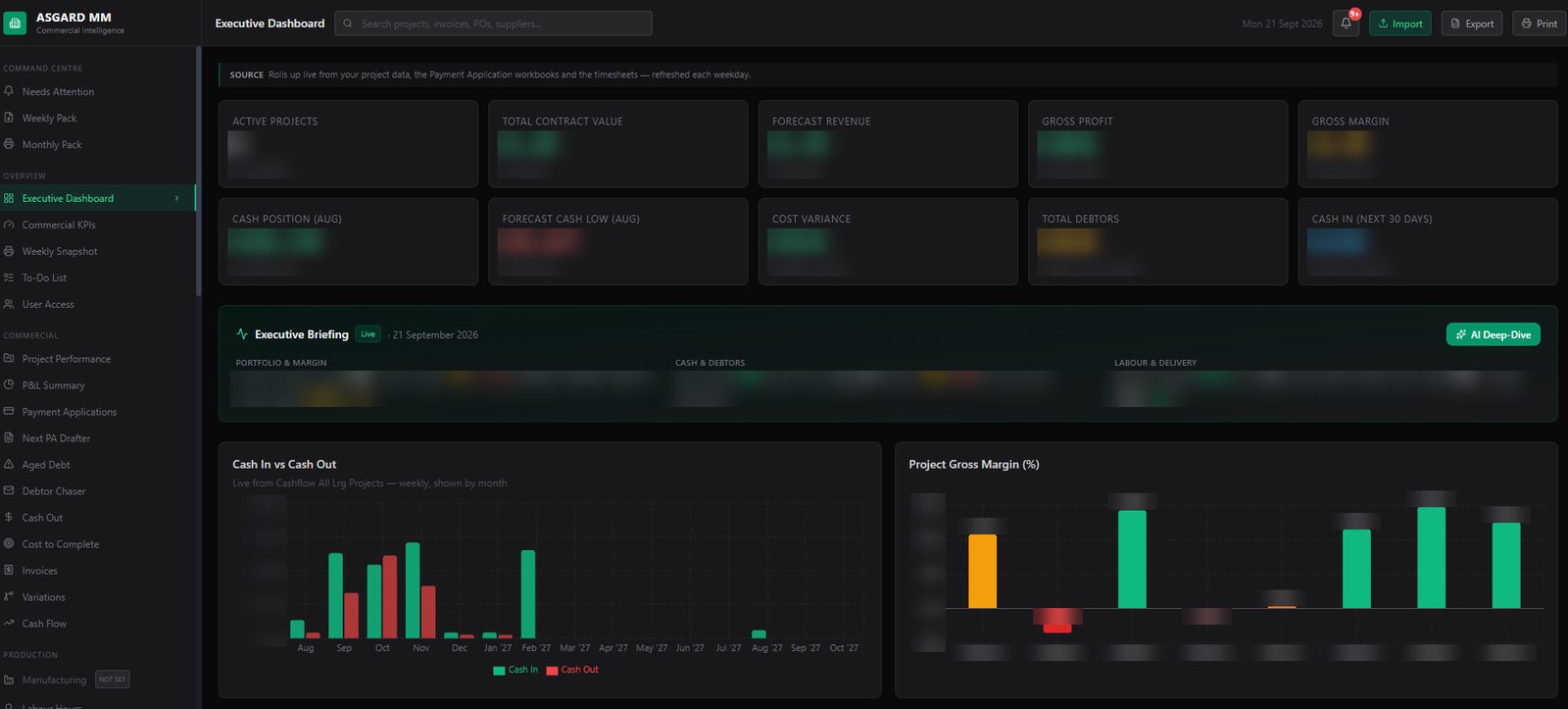
So instead of replacing Excel, we built a layer on top of it. An automated sync reads the existing files every hour and pushes the data into a live database, which powers a real-time dashboard on any screen.
Nothing about the team's day changed. They keep using the same files. The dashboard just reads them.
What the dashboard shows
- Live contract revenue, costs to date and projected final cost for every active project
- Gross margin and variance against budget, updated hourly
- Outstanding valuations and cash flow forecast
- Material procurement status and cost commitments
- No manual compilation — the data that used to take hours to assemble is simply there, live, whenever anyone needs it
The results
- Six hours reclaimed weekly. The reporting task is fully automated — roughly 300 hours a year returned to commercial work.
- Real-time cost visibility. Management can see the exact margin position on any contract at any moment, without waiting for end of week.
- Earlier intervention. Cost overruns surface within hours rather than days, while there's still time to act.
- No workflow change. The team continues using Excel exactly as before.
What happened next: once this dashboard proved itself, Asgard came back for a second system — QC Pro, their quality command centre. A repeat build is the most honest endorsement a system can get.